Embracing the EMC distinctives
Editors’ note: To wrap up our series on “The appeal of...” that ran from May/June 2025 to Mar/Apr 2026, Conference Pastor Andy Woodworth guides us in finding unity through diversity by embracing our key EMC distinctives.
Italian-British celebrity chef Gino D’Acampo appeared on the British TV show This Morning and prepared pasta carbonara live. As he completed the dish, co-host Holly Willoughby suggested adding bacon or ham. Gino strongly rejected the idea, saying, “If my grandmother had wheels, she would have been a bike!”
His passionate comment stems from his love of cooking and the belief that for a dish to be true to itself, it must include ingredients in specific proportions. Adding, subtracting, or substituting flavours or ingredients simply alters the dish. It eventually becomes something different from what it was meant to be.
For the past few years, I have asked what it means to be the Evangelical Mennonite Conference. What are the elements that make us who we are? What combination of flavours gives us a distinct style and approach to ministry that identifies us as being EMC? What values do we commonly hold that shape our ministry mindset? Because they exist. We may not be able to readily articulate just what those individual ingredients are, or their prominence in the overall makeup. But when we experience it, we just know: this is it. By contrast, we also know instinctively when something is just out of proportion.
The Messenger series “The appeal of…” explored a variety of ecclesiastical flavours: Reformed evangelicalism, traditional/liturgical practices, charismatic evangelicalism, progressive Christianity, and fundamentalism. We are not taking up a posture of fortifying ourselves against the influences of different leanings, nor wanting to be so ambiguous as to lose all sense of community identity. We see the value in exploring the appeal of other styles to gain a renewed appreciation for our own unique qualities.
Unity and diversity of the body of Christ
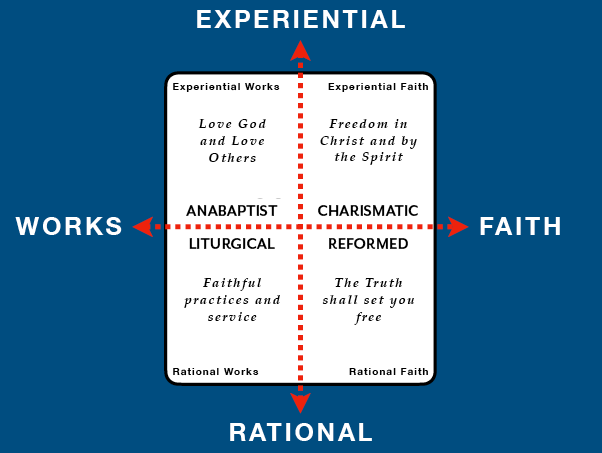
Diagram A
Part of our Mennonite culture is to avoid pride at all costs and always present ourselves in the humblest ways. However, recognizing what we do well and acknowledging the unique makeup of our Conference is not about taking pride in our own achievements. It helps us see that we contribute something meaningful to the overall church community. I believe there is something about the EMC that addresses specific needs within our culture, which is worth acknowledging.
As a visual learner, I like to use diagrams. In thinking about the overall work of the church, I use a box divided into four quadrants [see Diagram A]. The box is divided into two horizontal sections describing the key motivations for behaviours. The top half is Experiential, meaning behaviours are driven more by feeling than by reason, while the bottom half is Rational, meaning behaviours are driven more by reason than by feeling. The diagram is also split vertically to describe the expressive values. The left side is motivated by Works, valuing the practical application of faith. The right side is motivated by Faith, valuing beliefs that drive one’s practices.
Those motivated by Experiential Faith (upper-right quadrant), such as charismatics, hold beliefs that must be lived out through their words, behaviours, and worship. Those who operate with Rational Faith (lower-right quadrant), such as the Reformed movement, value well-articulated doctrine to adhere to a set of beliefs grounded in a high regard for Scripture as the Word of God. Within the Rational Works quadrant (lower-left), such as mainline or liturgical churches, they maintain carefully thought-through practices that they participate in to express or live out their faith. Finally, those inspired by Experiential Works (top-left quadrant), such as the Anabaptists, value the lived experiences of worshipping and serving together.
The true church is not comprised solely of those in our quadrant. We remember the words of Paul, who writes, “Just as a body, though one, has many parts, but all its many parts form one body, so it is with Christ” (1 Corinthians 12:12). We have brothers and sisters in Christ, who value elements of the Christian faith to differing degrees, and live out their heartfelt beliefs through a variety of expressions. When working in harmony, under the lordship of Christ, we are a transforming force within the world. When we are competing with one another for ecclesiastical superiority, then we are no more than “a resounding gong or a clanging cymbal” (1 Corinthians 13:1).
There exists a counterbalance within the body of Christ, obtained not by having all groups converge at the center as one homogeneous church, but by having a heterogeneous church marked by unified diversity. The EMC maintains certain distinctives that set us apart from other Christian churches in Canada. These nuances do not put us in competition with other churches. Instead, they are meant to enhance the church’s overall work. The important question is, “Do we recognize the value we bring to the table as the EMC?”
What makes us who we are?
Methodist theologian Albert Outler coined the phrase Wesleyan Quadrilateral to explain how Christian beliefs and practices are shaped by Scripture. Outler asserted that Scripture is understood through the lenses of tradition, reason, and experience. A few generations ago, the majority of members within the Conference would have been born and raised within an Anabaptist tradition. Most would have shared experiences of culture, language, and lifestyle (mostly rural). Sunday school curriculum, Bible college training, and Sunday sermons would have promoted commonly held theological thoughts, which shaped the EMC way.
Going back further, to historical Anabaptist tradition, six tenets were held dear: (1) Christ-centred reading of Scripture, (2) Salvation through repentance and obedience, (3) Active service as a demonstration of faith, (4) The believer as an agent of peace, (5) The visible church being the community of believers, and (6) Being in the world but not of the world. These beliefs contributed to the foundation of the EMC way.
Today, our members have not necessarily been born and raised within the Anabaptist tradition. Our experiences have been more diverse because of advancements in technology and the ease of travel. Our studies have included sources not necessarily restricted to or aligned with the traditional Anabaptist theological camp. Scripture, therefore, is no longer solely interpreted by the EMC way. The reality is, we struggle somewhat to define what the EMC way is anymore. We recognize that individuals and churches are, to varying degrees, being influenced by the appeal of Reformed evangelicalism, traditional/liturgical practices, charismatic evangelicalism, progressive Christianity, and fundamentalism. The EMC way has become murky.
We might say we are having a bit of an identity crisis as a Conference, but that does not have to be viewed negatively. We have the opportunity to engage in a conversation about values, beliefs, practices, and traditions. We have this moment to look honestly at who we are and reflect on who or what we want to be as we move forward. So, what do we want it to mean, to be EMC?
Our values define us
We are not a franchise of churches, all looking and sounding the same. Nevertheless, there is something that connects us—a flavour and texture that we recognize when we experience it. Exploring other church proclivities is meant to help us lean into what we are designed and gifted to be as the EMC.
You see, we value the fundamentals of the Christian faith, but we are not fundamentalists. We value Spirit-empowered living, but we are not charismatic. We value the exercise of progressing in our faith, but we are not progressive. We value the richness of ritual and tradition, but we are not liturgical. We value doctrine that re-forms the church and individuals, but we are not Reformed. All those ingredients may be present in our Conference, but mixed and proportioned in a way that defines us, that distinguishes us, that identifies us as the EMC.
At the heart of who we are, we see characteristics that define and empower us to contribute to the greater work of Christ in our world. A few years ago, we defined these as EMC Core Values, and they help clarify who we are today.
We Value Relationships and Christian Community: As a family of churches, we affirm that, in Christ, we are part of a shared faith story, historically and theologically, and that this fellowship builds us up. In offering mutual support, we learn from one another and are enriched together. We value the cooperation this relationship affords, realizing we can do more together than we can individually. (Ephesians 4:3–6; Galatians 3:26–29; Romans 12:4–5)
We Value the Truth: Jesus is the Truth, and he is faithfully revealed in Scripture. We hold biblical doctrine to be of primary importance and seek to interpret the Scriptures together. We value the theological approach of the early Anabaptists who read Scripture through the lens of Christ. (2 Timothy 3:16–17; Joshua 1:8; Luke 24:27, 44; John 5:39)
We Value People: Human beings are created in God’s image, and his desire is for all people to be reconciled to himself through Christ. That is our desire, too. With compassion, we seek to carry the good news of salvation in Christ to people near and far. (John 3:16; Luke 2:10–11; 2 Corinthians 5:20; Matthew 18:14)
We Value Obedience: We believe that to love Jesus is to walk in reverent obedience to him. He calls us to a life of love. Within this calling, we are to obey the commission of Christ to make disciples of all nations. (John 14:15, 21, 23; Romans 13:8–10; 1 John 5:1–3; Matthew 28:18–20)
We Value Discipleship: We value people growing in maturity as they follow Christ in a life of worship, prayer, and deepening faith. We value the calling and developing of mature church leaders. We want our faith to be seen in a life of integrity and authenticity. We want to discern God’s leading for our lives, individually and corporately. (Mark 8:34–35; Romans 12:1–2; James 2:17; Ephesians 4:13)
We are the EMC
When churches are growing, I will always ask them, “What are you doing to attract the people who are showing up?” Often, the church leaders cannot answer that question comprehensively. I’ve come to realize we don’t grow because of what we do, we grow because of who we are. Those values that define us—community, truth, people, obedience, and discipleship—are ingredients that, when combined, form the thing that many are longing for or need.
Whether we are talking about a conference, a church, or a Christian, when we do what we are created and gifted to do, in the way Christ leads us to do it, we find spiritual fulfillment, genuine results (good fruit), and a spirit of joy abounding. Asking what it means to be the Evangelical Mennonite Conference is not an attempt to change or undermine who we are, but to clarify it, so we can live it out with passion and confidence.
In the end, we do not want to think of ourselves more highly than we ought, but neither do we want to think of ourselves as insignificant to the broader work of the church or live in comparison to other styles of churches. We want to think of ourselves with “sober judgment” in accordance with the faith God has distributed to each of us, but that does not mean seeing ourselves in a disparaging or irrelevant way (Romans 12:3). The EMC has a role to play, and we want to be true to our calling, in our homes, our communities, our nation, and our world. Let us embrace and celebrate what it means to be the Evangelical Mennonite Conference.
Audio generated with AI voice technology.
Other articles in this series:
Why this young theologian was drawn to Reformed evangelicalism
Ancient, continuous, and meaningful: why traditional, liturgical church practices draw me
Personal, hope-filled and Spirit-empowered: the appeal of charismatic evangelicalism
Compassionate, questioning and messy: the appeal of progressive Christianity
Missional, faithful, and with a deep love of Scripture: the appeal of fundamentalism
The gospel is revealed in community: the appeal of the EMC