Contentment: the spiritual discipline of enough
Editor’s Note: This article was first published in the October 2025 issue of Christian Courier. It is reprinted with permission from the author.
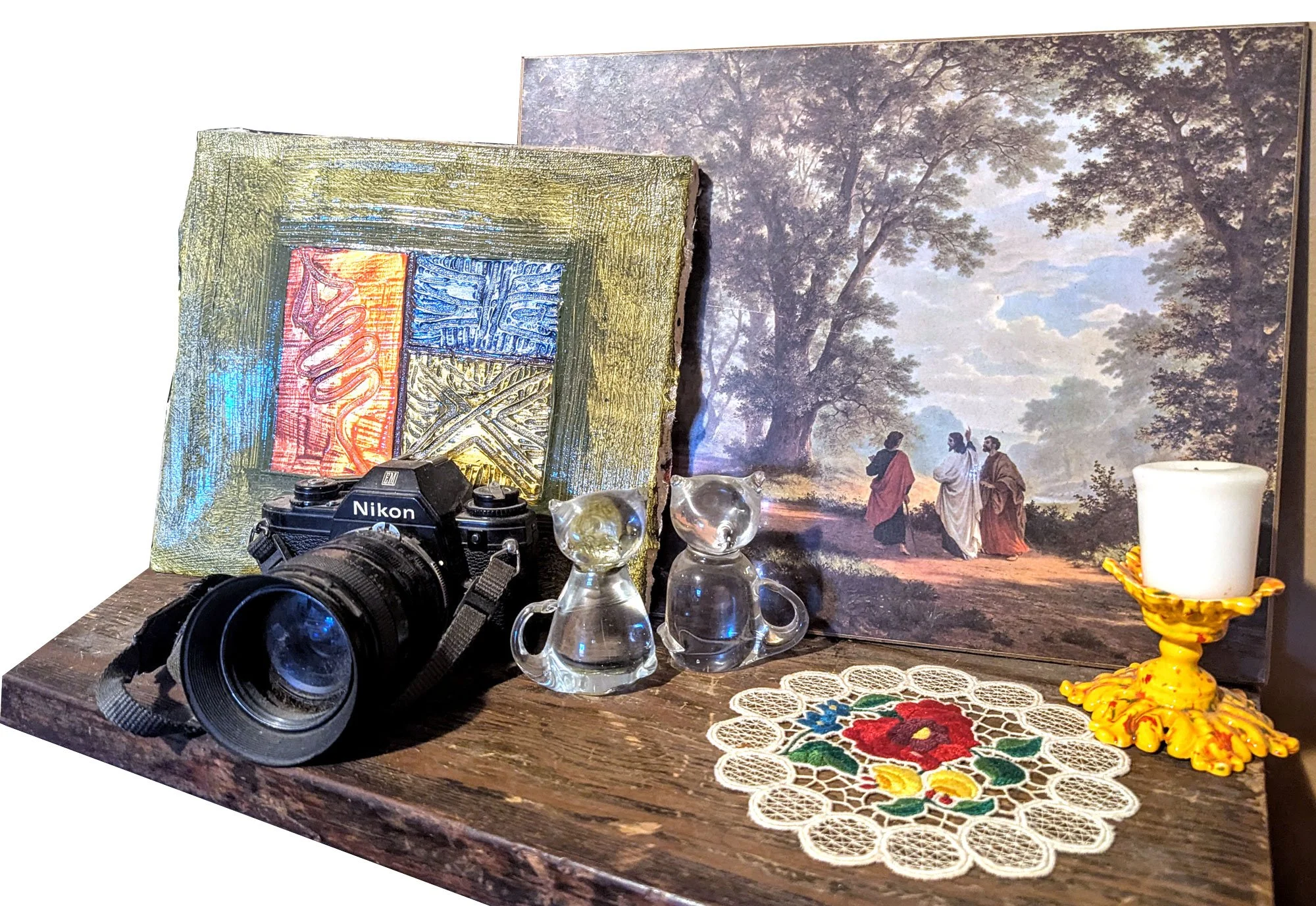
Vintage and thrifted items displayed in author Cindy Stover’s home, including a print of Robert Zund’s “Road to Emmaus” from a church rummage sale. (Cindy Stover)
I’m a big fan of thrifting. Clothes, furniture, books, art, you name it—my home is filled with second-hand deals and vintage items that I’ve collected over a lifetime. A few of my favourites are an art-deco dresser I inherited from my grandmother, floral tins that decorate my cupboards, and a print of Swiss artist Robert Zund’s “Road to Emmaus” that I picked up at a church rummage sale. Visitors have told me that my house looks like an eclectically curated treasure trove of “all the things Cindy would like at a thrift store.” (I’ve wisely chosen to receive that as a compliment.)
Dumpster diving
As a young student in Toronto in the early 2000s, the people in my neighbourhood were much more affluent than my roommates and I, who were surviving on student loans and savings from summer jobs. We learned to go for walks on garbage night, looking at what our upper middle class neighbours thought was trash, and finding perfectly usable coffee tables and bookshelves and even a pizza baking stone to bring back to our walk-up apartment.
We’d also salvage armloads of flowers from the dumpster behind the florist on the main floor of our building. We had fresh bouquets and homemade pizza until we all graduated and moved away from an increasingly expensive city. On a recent trip to Toronto, I drove past our old street and saw that the whole block has been razed to build condos. I guess only the affluent can afford to live in that neighbourhood anymore.
These days I’m less of a dumpster diver and more of a bargain hunter. If I’m in need of something, whether it’s a raincoat, a couch, a blender or snorkeling gear, I’ll search it out second-hand before ever considering buying it new (and yes, I’ve found all these things used and yes, I did thoroughly clean the snorkeling gear).
One of my favourite yearly events with my friends is what we call “Wine and Thrift Day.” I now live a short drive from Niagara, where dozens of wineries sit along Old Highway 8 from Grimsby to St. Catharines. There’s also a steady stream of thrift stores along that route, which gave us the idea for a great way to satisfy both the wine lovers and thrifty pals in our midst. We start with breakfast at a florist with a flower-filled café. Then we alternate between stops at thrift stores and wineries as we travel east, never staying too long at any of them so that we don’t overindulge in either, and then finish with a meal on a vineyard patio. We return with our trunks filled with clothes and trinkets and a nice bottle or two to bring home. It really is the best day!
Thrifty by necessity
I wasn’t always this enthusiastic about second-hand things. I grew up shopping at thrift stores, as my family lived on a single income. My dad was a nurse, and my mom worked hard to finish a degree after having two kids. I remember going through bags of hand-me-downs from church friends and visiting Sally Ann for specific items like snowsuits that were needed in cold Northern Ontario winters.
By the time I was in Grade 8, I was an awkward teen, self-conscious that I didn’t have the trendiest clothes. I remember visiting the store that had “the jeans” (the ones all the other girls in my grade were wearing) and trying them on just to see what they looked like. I desperately wanted those jeans, but they were $70 and I knew we couldn’t afford them. After a particularly rough day at school, my mom and I were at the mall and I pleaded with her, “I’ll never fit in until I have those jeans!” By some miracle, she agreed and we bought them! I was delighted. (If you’re reading this, Mom, thanks for making a teenager’s dream come true, even though I suspect that it probably meant we missed a bill payment that month.)
Nowadays, thrifting can even be considered cool. I hope that today’s Grade 8 students can be less captive to the materialism of having to wear the right brands or the perfect pair of jeans. There’s social media pressure, but clothes can also be seen as a way of expressing our personalities, a reflection of our varied interests and styles. While many young people today still seem drawn to expensive yoga pants or bougie sneakers, I hope there’s no longer the same ostracism towards those who dress differently. People should wear what they like!
Fast fashion
This changing sensibility is about more than simply being frugal. People also thrift for many reasons beyond budget. Some truly love the aesthetic of a different era, and prefer vintage T-shirts and antique dishes over items mass-produced offshore. Some want to support local charities and know that for each trunk-load they drop off, they can bring home a bag of new treasures.
Many increasingly realize the true costs of fast fashion and home decor that changes every season. These industries are built on capitalist systems that take a horrific toll on the human labour that is exploited to produce cheap garments and home goods, along with the toxic environmental impacts of products that are designed for obsolescence. Many of these trends soon end up in landfills when they’re no longer serviceable or in style. It’s no wonder that seeking out second-hand has become a lifestyle choice, a personal “no thanks” to participating in these systems that degrade creation and our fellow image-bearers.
Enough
Our inner lives are also impacted by our consumer choices. We each need to discern the faithful balance between earthly necessities and “storing up treasures in heaven” to learn how to be generous with the blessings we’ve received, and to get comfortable with knowing when we have enough. This kind of openhandedness can be a difficult muscle to develop in a world that tells us our worth is defined by what we own, or by the image we project.
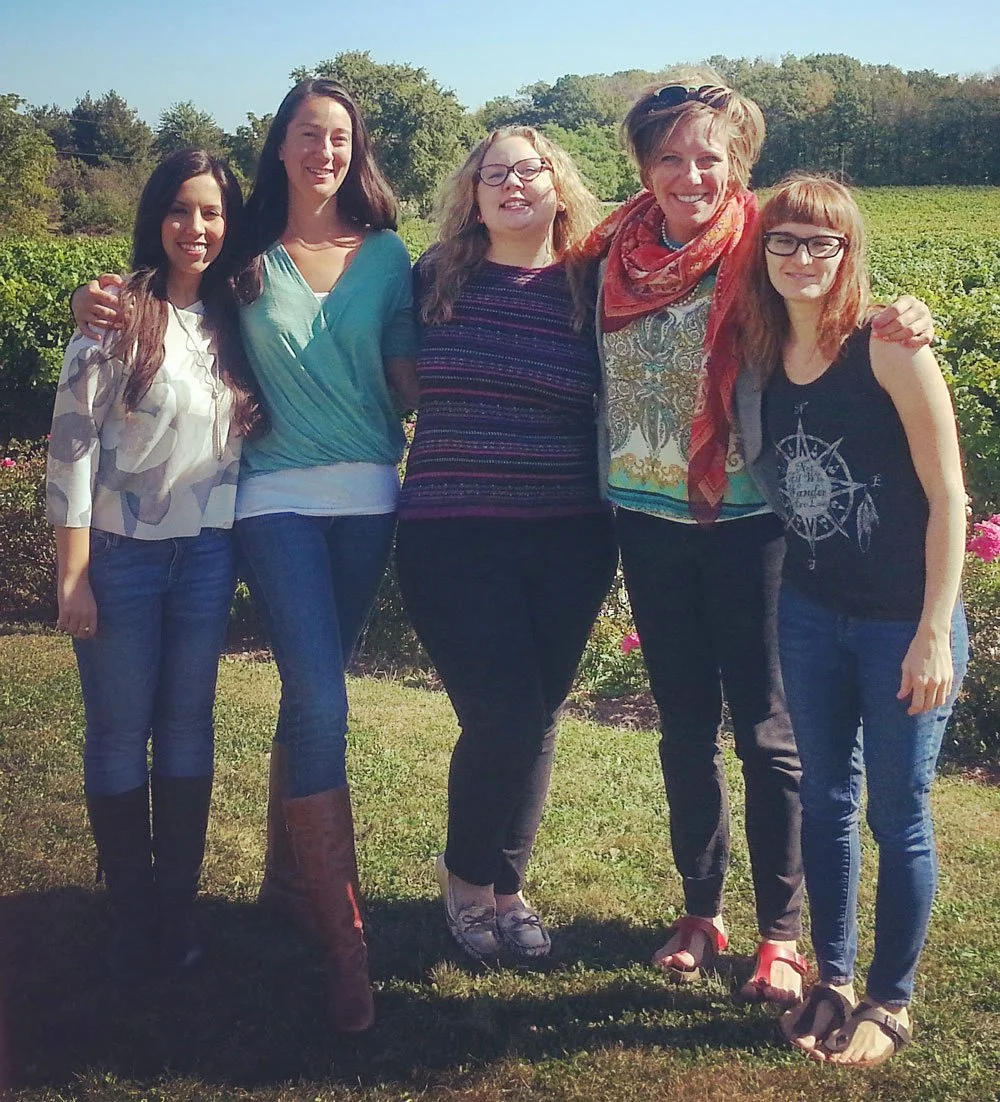
Cindy Stover (middle) and friends on a “Wine and Thrift” tour. (Cindy Stover)
If I’m being honest, I’ve certainly coveted my share of status items—whether that was a car with air conditioning that actually worked, or a Smart TV to replace my perfectly functional but no bells-and-whistles TV. Or, most embarrassing of all, a self-cleaning robot kitty litter box. (Confession: I did get the robot litter box, albeit second-hand, and I did thoroughly sanitize it. But my cats refused to use it because to them it was a giant motorized toilet monster! So even second-hand, that was a waste of more money than I’d like to admit.)
It’s absolutely possible to get so wrapped up in the next best thing, or at least the next best deal, that our thrifty ways can still shape us towards overconsumption. I certainly could never be accused of being a minimalist (bless the hearts of those who can manage that lifestyle), but that doesn’t mean that I have to be a maximalist (even if the pictures here may suggest otherwise). It’s one thing to find a souvenir at a garage sale that reminds you of the town you grew up in; it’s entirely another thing to thrift compulsively because you can’t be satisfied with what you already have.
Gift mindset
Developing that spiritual discipline of contentment requires intentionality. To be truly open-handed, we need to loosen our grip on what we mistakenly think is ours to begin with. That often means setting a budget that restrains what we spend on ourselves and predetermines what we donate to charity. But it’s about more than budget lines; we need to learn to go beyond ourselves, thinking more about what we can give than what we can get. To develop this sort of gift mindset, we can practice looking for opportunities to share or help out; perhaps a neighbour could use your extra bookshelf; perhaps a family at church could use the clothes your kids have outgrown; perhaps a newcomer getting their own apartment could use your help this weekend.
We also can move beyond the monetized economy entirely and put more time and energy into the values behind “reduce, reuse, and recycle.” Can we simply use less? Organize a clothing swap? Fix something before throwing it away? I learned how to change the belt on my dryer by watching a YouTube video! Can we find ways to save things that are going to waste? Maybe we can borrow tools from a neighbour instead of buying them to use once, order from thriftbooks.com instead of Amazon, or check if the very specific thing you need is on a social media marketplace before automatically going to a department store. That’s how I got the snorkel gear!
Now that I’m an auntie, I spend more time second-hand shopping for the next generation than for myself. My last thrifting adventure resulted in a pair of practical walking shoes for my next Europe trip, while the rest of my bag was filled with back-to-school clothes for my niece and nephew, who seem to grow a size or two every six months! I found the coolest jean jacket for my niece (which cost nowhere near $70). She’s just starting Grade 8 this year and has been asking for a jean jacket for a while. I really do hope this one makes her just as delighted as I was with my own jeans all those years ago.
Audio is generated with AI voice technology.